Every Gate Tells a Story: The Secret Language Carved Into Romanian Wood
Picture a gate. Not a chain-link fence, not a suburban privacy panel from Home Depot. A gate that took a master craftsman six months to build. A gate so dense with carved suns, twisted ropes, and interlocking trees that standing in front of it feels less like approaching a house and more like reading the opening page of a very old book — one written in a language you almost, almost recognize.
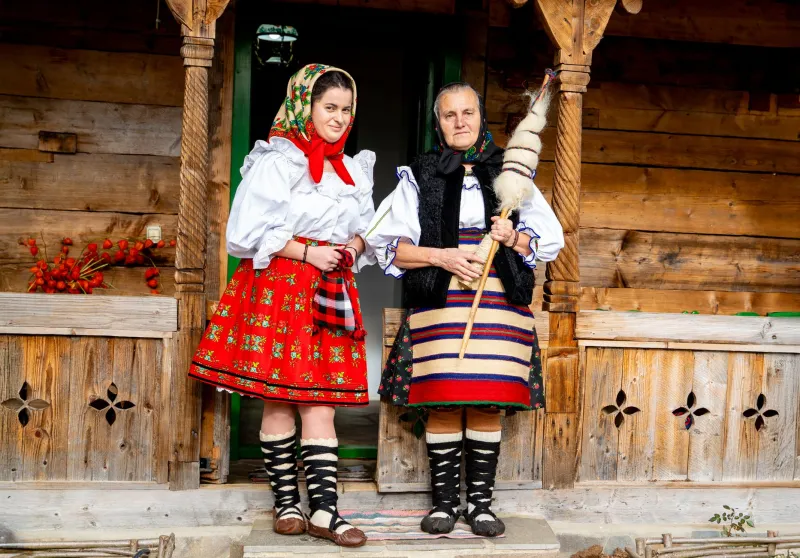
That's what you get when you visit the villages of Maramureș, a region tucked into the northern corner of Romania where the Carpathian Mountains crowd the sky and the old ways have held on longer than almost anywhere else in Europe. Here, the wooden gate — poarta in Romanian — has functioned for centuries as something far more loaded than a property boundary. It was a family's public face, a spiritual shield, and a visual autobiography all at once.
The Gate as a Family Portrait
In traditional Carpathian villages, you could learn almost everything you needed to know about a household just by studying its gate. Height mattered — taller gates signaled prosperity and standing in the community. The number of decorative columns told you how many sons the family had. Specific carved motifs announced the family's religious devotion, their connection to the land, or their wish for protection against forces that didn't have names people said out loud in polite company.
The craftsmanship itself was never casual. Oak was the preferred material — dense, slow to rot, stubborn in the way that good things tend to be. A master woodcarver, called a meșter in Romanian, might spend an entire season on a single commission. The work wasn't just decorative. It was intentional in the way that illuminated manuscripts were intentional: every element placed with purpose, every symbol carrying weight.
And the symbols? They form a visual vocabulary that outsiders couldn't easily decode. The soarele — the sun motif — appears constantly, radiating from gate panels in forms ranging from simple carved circles to elaborate geometric explosions. It wasn't purely aesthetic. In Carpathian folk belief, the sun was protective, a force that kept darkness at bay. Carving it into the wood at the entrance of your home was a way of saying: what lives here is watched over.
Ropes, Trees, and Things That Never End
Then there's the rope motif — funia — a twisted, continuous braid that winds along the horizontal beams of traditional gates. It looks decorative until you understand what it means: eternity. The unbroken line has no beginning and no end, which in the Carpathian symbolic system represented the continuity of family, the unbroken thread between the living and the dead, and protection from evil spirits, which — according to folk belief — could only travel in straight lines. A twisted rope, then, was essentially a spiritual obstacle course.
The pomul vieții, or Tree of Life, shows up on gates and household objects alike. Rendered in carved wood, it typically appears as a stylized tree with symmetrical branches, sometimes with birds perched at its tips or animals grazing at its roots. It's a motif so ancient that versions of it appear in Mesopotamian artifacts, on Dacian pottery, and in Romanian folk textiles all across the centuries. When a Maramureș woodcarver chiseled it into a gate post in 1820, they were participating in a symbolic conversation that stretched back thousands of years — even if they might not have described it that way.
What makes this tradition genuinely remarkable is how coherent it remained across generations without any formal institution preserving it. No guild wrote it down. No university catalogued it. It survived because masters passed it to apprentices, fathers passed it to sons, and villages held collective memory in the way that only small, tight communities can.
The Meșteri Who Are Still at It
The tradition nearly broke. Communism hit Romanian folk crafts hard — not always through outright suppression, but through the slower damage of industrialization, rural exodus, and the general bureaucratic hostility toward anything that smelled like regional identity or pre-modern spirituality. Many villages that once had active woodcarving traditions lost their masters without producing successors.
But Maramureș, stubborn as oak, held on. Villages like Săpânța, Budești, and Vadu Izei still have working woodcarvers producing gates in the traditional style. Some of them are in their seventies and eighties, working with hand tools their grandfathers used. Others are younger — in their thirties and forties — who made a deliberate choice to learn the craft when they could have left for Bucharest or Cluj or somewhere with better Wi-Fi.
One of the more compelling stories in contemporary Romanian woodcarving circles involves craftspeople who grew up in diaspora communities and made the trip back to Maramureș specifically to apprentice with older masters. They arrived with smartphones and left with chisels and calluses and a working knowledge of a symbolic vocabulary that most of the world has never encountered.
From the Carpathians to the Farmers Market
Which brings us to the part of this story that hits differently if you're reading it from, say, Ohio or Oregon. A small but growing number of Romanian-American woodcarvers have started bringing this tradition to workshops, craft fairs, and farmers markets across the US. They're not making full-scale gates for suburban driveways — though if you wanted to commission one, apparently the conversation is worth having. They're producing smaller work: decorative panels, wall hangings, hand-carved household objects, all encoded with the same symbolic grammar that Maramureș craftspeople have been using for centuries.
At craft events in cities with significant Romanian-American communities — Chicago, Detroit, Cleveland, parts of California — you'll occasionally find a booth where someone is demonstrating the chisel work live. Watching it happen is its own kind of education. The symbols don't appear randomly. The carver makes choices, and if you ask them why they placed a sun motif in a particular corner or why the rope braid runs the direction it does, they can tell you. The work has a logic. It has a grammar. It's a language, and it's still being spoken.
Why It Matters More Than You'd Think
There's a tendency in American craft culture to appreciate things like this aesthetically — it's beautiful, it's intricate, wow, the detail — without fully registering what it represents. A Maramureș gate isn't just a beautiful object. It's evidence that a community developed a sophisticated, layered communication system out of wood and hand tools, and that system encoded their values, their fears, their hopes for their children, and their relationship with the invisible world — all without a single written word.
That's not a minor thing. That's a civilization's worth of meaning compressed into oak and chisel marks.
So the next time you're at a craft fair and you see someone selling hand-carved wooden panels with geometric patterns you don't immediately recognize, stop. Ask. The person behind the table might be able to tell you that the twisted rope means eternity, the eight-pointed star means protection, and the tree in the center means that whoever lives with this object in their home is connected — forward and backward — to something much larger than themselves.
That's a lot to fit on a farmers market table. But then, Maramureș craftspeople have always been good at fitting a lot into a small space.