Before GPS and Weather Apps, Carpathian Shepherds Had Something Better
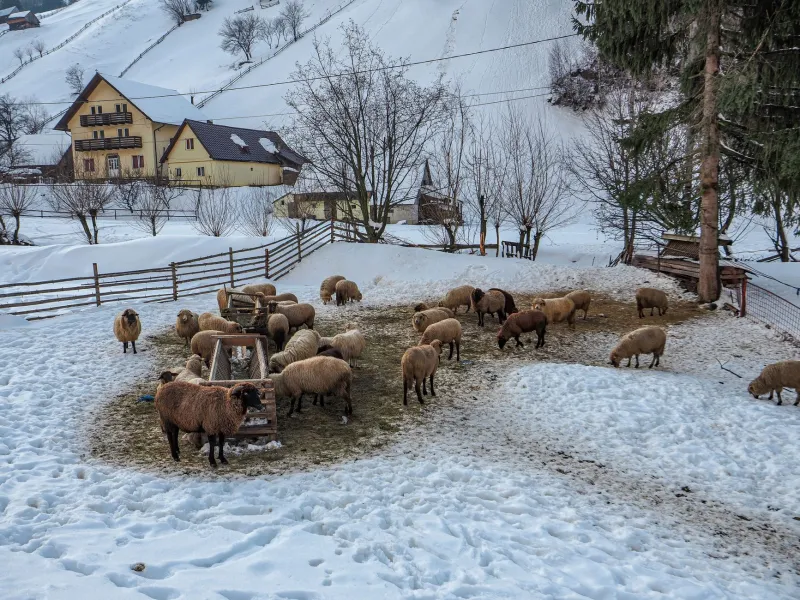
Imagine you're responsible for several hundred sheep. You have no phone, no almanac, no weather radar. What you do have is a mountain that's been trying to kill people — and feed them — for thousands of years. And you have your grandfather's voice in your head, telling you what it means when the sheep press together before noon, or when the wild roses bloom two weeks early, or when Saint George's Day arrives cold.
That's not superstition. That's a system. And for the shepherds of the Carpathians, it was the only system that mattered.
The Road the Flocks Made
To understand the shepherd's calendar, you first have to understand transhumanță — the ancient practice of moving flocks between high mountain pastures in summer and lower valley lands in winter. Twice a year, tens of thousands of sheep and their keepers would travel hundreds of miles along routes so well-worn they carved permanent paths into the landscape. These weren't casual walks. They were migrations, and they ran on a calendar so precise it made modern scheduling look sloppy.
The timing of these movements wasn't arbitrary. It was calibrated to centuries of observation — of snowmelt patterns, grass growth cycles, the behavior of rivers, and the crowded liturgical calendar of the Orthodox Church. Saint George's Day (April 23rd) traditionally marked the start of the summer ascent. Saint Dumitru's Day (October 26th) signaled the return to the valleys. Miss the window on either end, and you could lose animals to late frosts or early blizzards. The saints weren't just religious figures — they were seasonal anchors.
Reading the Sky Like a Book
Carpathian shepherds developed what ethnographers sometimes call a "phenological calendar" — a way of tracking time through biological and environmental cues rather than numerical dates. But calling it that makes it sound drier than it actually was. This was living knowledge, told in stories and proverbs, not charts.
A ring around the moon meant rain within three days — reliable enough that shepherds would shift camp accordingly. If the cattle grew restless and refused to graze in the afternoon, a storm was coming faster than the clouds suggested. An early abundance of berries on the mountain ash tree meant a hard winter ahead; the mountain, in a sense, was stocking up. Even the behavior of ants — how high they built their mounds, how frantically they moved before a pressure change — fed into the system.
The Carpathians are moody mountains. They don't give you much warning when the weather turns. So the shepherds learned to read everything: the direction smoke drifted from a fire, whether dew formed heavily or not at all, the angle at which swallows flew. None of these signs were treated as absolute. They were combined, weighed against each other, and filtered through years of personal experience. Think of it less like a rulebook and more like a language — one you had to be fluent in before the mountain would speak to you plainly.
The Saints as Meteorologists
The Orthodox liturgical calendar gave the shepherd's year its scaffolding. But the saints who populated it weren't just holy figures — they were, in the folk imagination, personalities with specific powers over weather and livestock.
Saint Elijah (Sfântul Ilie), celebrated in late July, was associated with thunderstorms. Farmers and herders alike believed he rode a fiery chariot across the sky when lightning struck — not a metaphor, but a genuine working belief that shaped behavior. You didn't work in the fields on his feast day. You didn't tempt fate.
Saint Andrei (Saint Andrew's Day, November 30th) marked the transition into the dangerous heart of winter and carried heavy superstition around wolves — animals that were a constant, lethal threat to flocks. Protective rituals performed on that night weren't quaint customs; they were the psychological armor of people who understood exactly what wolves could do to a herd.
And then there was the Filipii — a cluster of days in late autumn dedicated to a group of saints collectively feared as protectors turned punishers. Work the wrong kind of task during Filipii, and your livestock would suffer. The line between religious observance and practical herd management blurred constantly in this world, and that blurring was intentional. The calendar held everything together.
What the Animals Knew
Maybe the most fascinating piece of the shepherd's knowledge system was the attention paid to the animals themselves as forecasters. Sheep, cattle, dogs — each species had its own behavioral vocabulary that a skilled shepherd could interpret.
When a lead sheep — the berbec de frunte, the bellwether — grew unusually skittish without obvious cause, it was worth paying attention. When dogs howled in an unusual pattern or refused to leave the shelter of the fold, experienced herders took note. Modern science has since confirmed that many animals are sensitive to barometric pressure changes, infrasound, and electromagnetic shifts that precede severe weather. The shepherds didn't have that vocabulary, but they had the observation. They had centuries of it.
There's something almost eerie about how accurate some of these animal-based predictions turned out to be. Or maybe "eerie" is the wrong word. Maybe it's just humbling.
A Knowledge System on the Edge
Here's the uncomfortable part: most of this is going away. Transhumanță still exists in Romania — it's even been added to UNESCO's list of intangible cultural heritage — but the number of shepherds who carry the full oral tradition is shrinking fast. Younger generations are leaving mountain villages. The routes that flocks traveled for millennia are increasingly interrupted by roads and fences. The proverbs that encoded centuries of weather observation are fading from use.
Ethnographers and folklorists have been scrambling to document what remains, and some of that work is genuinely extraordinary. Organizations across Romania have been recording elderly shepherds, archiving the proverbs, mapping the old transhumanță routes. It's conservation work, in the truest sense — except what's being conserved isn't a forest or a species. It's a way of knowing.
Why It Still Matters
For an American audience, this might feel like a long way from anything relevant. But consider: we're living through a moment of intense cultural interest in exactly what the Carpathian shepherds mastered — seasonal living, reading natural cues, sustainable relationships with land and animals, reconnecting with pre-industrial rhythms. The "slow living" movement, the obsession with foraging and phenology and traditional ecological knowledge — all of it is circling around something the Carpathian highlands preserved in working form until very recently.
The shepherd's calendar wasn't romantic. It was practical, hard-won, and often brutal. But it was also a complete system — one that told you not just what time it was, but what kind of time it was, what it meant, and what you were supposed to do about it.
There's a Romanian proverb that translates roughly as: "The mountain teaches, but only to those who listen." The shepherds listened for eight thousand years. The least we can do is pay attention while there's still someone left to tell us what they heard.