Americans Are Flying to Romania to Sit Inside a Salt Mountain — And Coming Home Changed
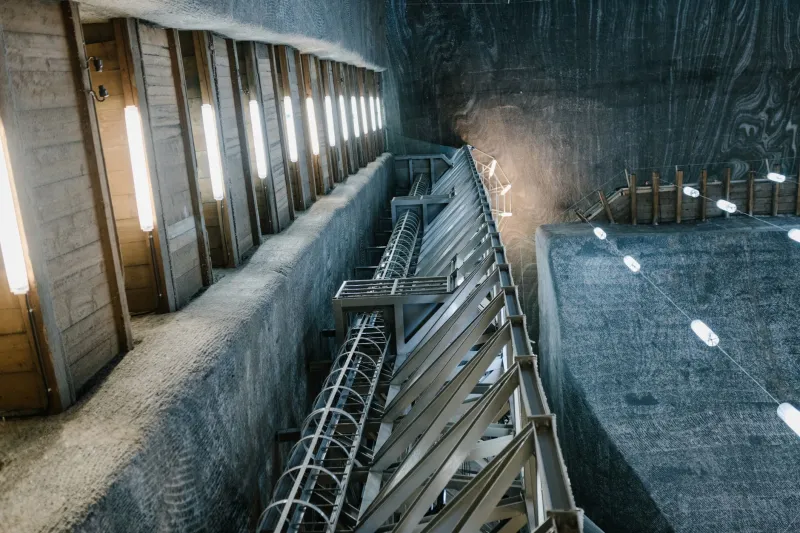
Sarah Hoffman, a 38-year-old occupational therapist from Portland, Oregon, did not expect to cry inside a salt mine. She'd booked the trip to Romania mostly because flights were cheap and she'd heard Transylvania was beautiful. The wellness component — a visit to the Turda Salt Mine in Cluj County — felt like a quirky add-on, the kind of thing you do because it's on the list.
"I walked down into this enormous underground chamber," she says, "and something just shifted. I don't have a better word for it. The air was different. The sound was different. And there were Romanian families down there — kids playing, older people sitting quietly, a few people who looked like they'd been coming for years. It didn't feel like a tourist attraction. It felt like a place."
She stayed for three hours. She's already planning to go back.
The Mine That Predates Modern Medicine
The Turda Salt Mine has been in operation in various forms since the 17th century, but the salt itself has been harvested from the Carpathian region for thousands of years. What's less commonly known outside Romania is that these underground spaces have functioned as healing environments for most of that history — not as metaphor, but as literal medical practice.
The microclimate inside a deep salt mine is genuinely unusual. The air is saturated with fine salt particles, almost entirely free of allergens and pollutants, maintained at a steady cool temperature year-round. Respiratory conditions, chronic inflammation, skin disorders — Romanian folk medicine has pointed people toward salt caves and mines for these problems since before written records of the practice exist. Contemporary speleotherapy (the clinical use of salt cave environments for respiratory treatment) is now recognized in European medical literature, though it remains largely outside mainstream American healthcare.
But the physical environment is only part of what's drawing US visitors. The other part is harder to quantify.
Communal Healing as a Lost Technology
Romanian traditions around illness and recovery have never been primarily individual affairs. The folk medicine tradition carried by Carpathian communities — much of it preserved and practiced by the wise women known as descântătoare — operated on the assumption that healing was a social event. You didn't get better alone. You got better inside a web of relationships, ritual, and shared space.
This is a radical departure from the American wellness model, which tends to be intensely personal — your supplements, your meditation app, your therapist, your journey. The Carpathian model says that's the wrong unit of analysis. The community is the unit. The healing space is shared.
Anthropologist Mihaela Popescu, who studies Romanian folk healing practices and has consulted with several US-based wellness researchers, frames it this way: "What you see in traditional Romanian healing spaces — whether it's a salt mine, a sacred spring, a village ritual — is the deliberate creation of environments where people are not alone with their suffering. That's not incidental. That's the whole point."
For Americans navigating what the US Surgeon General has officially called a loneliness epidemic, that reframe lands differently than it might have a decade ago.
What the Travelers Are Actually Saying
The informal network of US visitors who've made the trip to Carpathian healing sites — salt mines, mineral springs, monastery retreats — is small but growing, and the accounts they share online have a consistent texture that's hard to dismiss as placebo or tourist enthusiasm.
Marcus Webb, a 45-year-old high school history teacher from Atlanta who visited the Slănic salt mine in Prahova County last summer, describes sitting in the underground amphitheater (yes, there is an underground amphitheater, carved from salt, with a basketball court and ping-pong tables, because Romanians have an interesting relationship with the surreal) and feeling something he struggled to name.
"It wasn't relaxation exactly," he says. "It was more like — permission to stop. Like the space itself was saying you don't have to be productive right now. And being underground, surrounded by all these other people who were also just... being there... it was the least lonely I'd felt in years. Which makes no sense because I was surrounded by strangers."
It makes more sense if you understand that the mine has been a communal gathering place for Romanian families for generations. The ritual of going down together — into the earth, into the salt, into the strange quiet — carries accumulated cultural weight that visitors absorb even without knowing its history.
Old Practice, New Urgency
The timing of this emerging interest is not coincidental. American wellness culture has been running hard on individualized solutions to collective problems for decades, and there's a growing sense — measurable in book sales, therapy waitlists, and the sheer volume of loneliness discourse — that something structural is missing.
Carpathian healing traditions don't offer a supplement stack or a productivity hack. They offer something more demanding and potentially more effective: the idea that the cure for isolation is designed space and communal ritual, not personal optimization.
The salt mines are just the most photogenic entry point. Behind them is a whole tradition — mineral springs believed to carry specific healing properties, pilgrimage routes to mountain monasteries, seasonal rituals that pull communities together around shared vulnerability and shared recovery — that has been quietly functioning for centuries while the West was building individualized healthcare systems.
Sarah Hoffman, back in Portland, has started researching Romanian speleotherapy literature. She's also started a small informal group that meets monthly — no agenda, no facilitator, just people sitting together in her living room. She calls it a pale imitation. But she says it's the closest she's found to what she felt underground in Turda.
"I think we've forgotten that being witnessed by other people is part of how humans heal," she says. "The Romanians didn't forget. They built a basketball court inside a mountain to make sure people kept coming back."