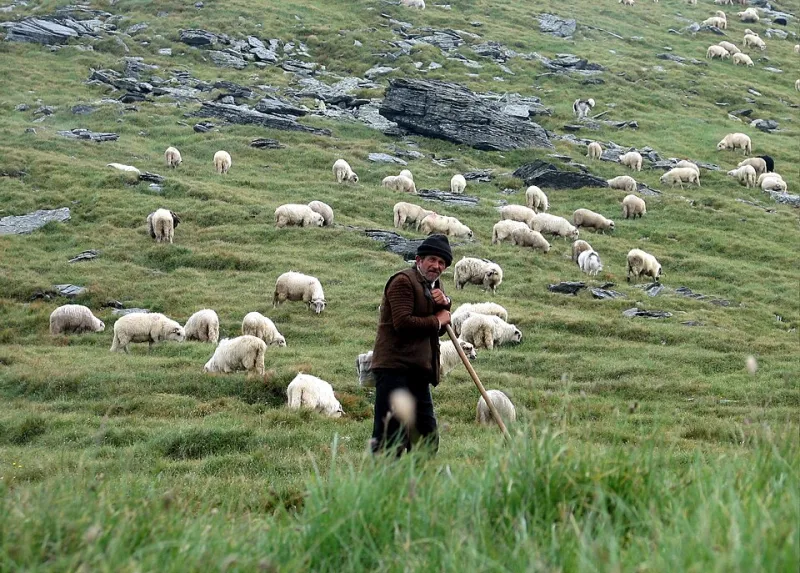
The Outlaw Who Never Was — and Always Will Be: How Haiducii Stories Change Based on Who's Telling Them

Photo by Photo by Margarita Shtyfura on Unsplash on Unsplash
There is a figure in Romanian folk tradition named Iancu Jianu. He was a real person — born around 1787, died around 1842, operated as a haiduc in Oltenia during a period of significant political upheaval. The basic biographical facts are not seriously disputed.
Everything else about him is a battlefield.
In Romanian folk songs and oral tradition, Jianu is a protector of the poor, a man of almost supernatural bravery who robbed from corrupt boyars and Ottoman administrators and gave what he took to the people who had nothing. In the Ottoman administrative records that survive from the same period, he appears as a dangerous criminal, a destabilizing element, a problem to be solved. In the accounts of Western European travelers who passed through Wallachia in the early 19th century, he shows up as a colorful local character — romantic, exotic, vaguely threatening, more symbol than person.
Three sources. Three completely different human beings, wearing the same name.
The Archive as a Political Document
This isn't a problem unique to Romanian history, but it's unusually visible here, and unusually instructive. The haiducii operated in a space that was contested not just militarily and economically but narratively. Every major power with a stake in the Carpathian region — the Ottoman Empire, the Habsburg administration to the west, the local boyar class, and the Romanian peasant communities themselves — had strong reasons to tell the story of these outlaws in a particular way.
For the Ottomans, the haiducii were criminals and chaos agents. Acknowledging them as principled resistors would mean acknowledging the legitimacy of resistance, which was not a story the empire wanted circulating. So the administrative records flatten them into bandits, strip them of political motivation, and focus on the disruption they caused to trade and taxation.
For Romanian communities under pressure from multiple directions simultaneously, the same figures became something closer to saints. The folk song tradition — the epic ballads called cântece haiducești — didn't just celebrate the outlaws; it actively constructed them as moral exemplars. The songs weren't journalism. They were argument. They were saying: this is what a good man looks like when the law itself is unjust.
For Western European observers, the haiducii fit neatly into a 19th-century Romantic template of the noble savage — fierce, free, uncorrupted by civilization. The accounts written by travelers like those who contributed to journals in Vienna or Paris often tell you more about what European Romanticism needed to believe about the Balkans than about what was actually happening in the mountains.
What Americans Are Actually Responding To
The haiducii are having a genuine cultural moment in American pop culture — not huge, but measurable. They show up in games, in fantasy fiction, in discussions about historical resistance movements on social media platforms where Balkan history has found surprisingly large audiences. And the American engagement with these figures tends to focus on exactly the ambiguity that makes historians nervous.
Americans seem drawn to the haiducii because their authenticity is contested, not despite it. There's something in the current cultural moment — deep institutional distrust, hunger for principled resistance, exhaustion with official narratives — that makes a figure whose story changes depending on who's telling it feel more honest, not less.
Media scholar Dana Ionescu, who studies how Balkan historical figures circulate in Western digital culture, puts it this way: "The haiducii function as a kind of Rorschach test. What you see in them tells you what you're looking for. Americans who are frustrated with power structures tend to see the Robin Hood archetype. People interested in military history see the tactical sophistication. Romanians in diaspora communities often see something more complicated — a symbol of identity that's real and constructed at the same time."
That last framing — real and constructed simultaneously — is actually the most historically accurate. The haiducii were real people doing real things with real consequences. And they were also, from almost the moment they existed, being turned into stories that served someone's argument about how the world worked and who deserved power in it.
The Propaganda Machine That Never Stopped
What's particularly fascinating about tracing haiducii narratives across sources is watching how each retelling serves a specific present-tense political need.
In the 19th century, as Romanian nationalism was building toward independence, the haiducii were actively recruited into a national origin story. Figures like Jianu and Pintea Viteazul were reframed not just as local heroes but as proto-nationalists — men who had been fighting for Romanian identity long before the concept existed in its modern form. This was historically dubious but politically useful. You can see the same move in American mythology around the Founding Fathers, or in how the French Revolution has been claimed by everyone from conservatives to anarchists.
In the communist period, the haiducii got reframed again — this time as proto-socialist class warriors, men who had understood before Marx that the property of the wealthy was stolen from the poor. The folk songs got republished in editions that emphasized this reading. The peasant-protection angle got amplified; the religious and traditional elements got quietly minimized.
And now, in the age of global digital culture, the haiducii are being refracted through yet another lens — the non-state actor with principles, the decentralized resistance movement, the ethical guerrilla. Each generation finds in these figures exactly what it needs to find.
The Version That Might Be Truest
If you want the version of the haiducii story that's most resistant to being weaponized for any single agenda, it might be the most uncomfortable one: these were human beings operating in impossible conditions, making choices that were sometimes brave and sometimes brutal, who became legends precisely because their actual complexity was too unwieldy to be useful. The legend simplified them. The legend made them usable.
What the folk songs preserved, though — underneath the heroics — is something worth taking seriously. They preserved the moral argument. The claim that there are conditions under which official law loses its legitimacy. The claim that communities have the right to protect themselves by means the powerful would prefer they didn't have access to. The claim that how you treat people who can't fight back is a measure of who you actually are.
You can argue about whether any specific haiducii figure actually lived up to those principles. The historical record is too fractured to settle that question. But the fact that the argument kept getting made — in song, in story, across centuries and through multiple political regimes that tried to control its meaning — says something real about the people who kept making it.
That's the version that doesn't resolve cleanly. It's also probably the truest one.