500 Years of Rain, Wars, and Empires Couldn't Wash These Frescoes Off the Wall
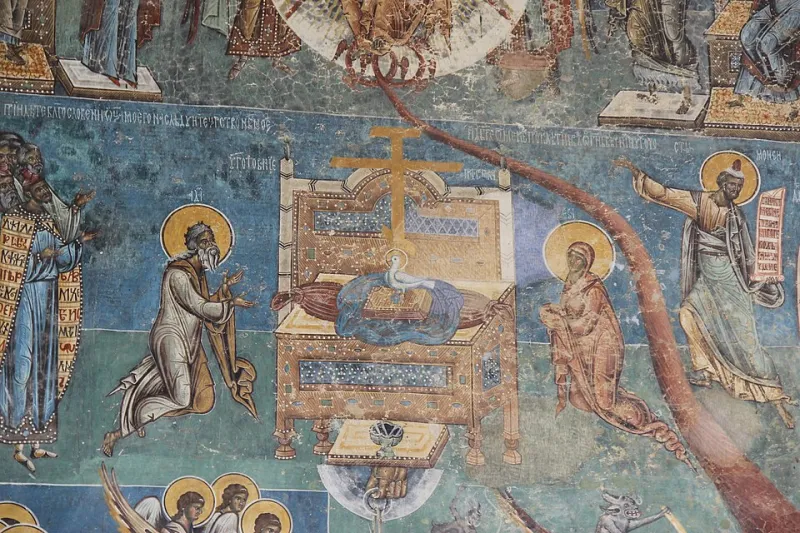
Photo: Gary Todd, CC0, via Wikimedia Commons
Medieval art TikTok is having a moment right now, and honestly, the algorithm has good taste. But if your feed has served you illuminated manuscripts and glowing stained glass and you think you've seen the peak of medieval color, hold on — because there's a corner of northern Romania where the walls themselves have been glowing since before Columbus bumped into a continent.
They're called the painted monasteries of Bucovina, and they break one of art history's most reliable rules: exterior frescoes aren't supposed to survive.
Walls That Were Never Meant to Stay Dry
Here's the problem with painting the outside of a building: rain. Sun. Freeze-thaw cycles. Snow. Any conservator will tell you that plaster and pigment exposed to the elements should flake, fade, and vanish within a couple of centuries, tops.
Now walk into the courtyard of Voroneț and look up. The entire western wall — a full-sized masterpiece called the Last Judgment — is still saturated with a blue so vivid it has its own name. Voroneț blue, a pigment that became legendary across the region and that nobody has ever fully replicated. Lapis lazuli, ground to powder, mixed into the plaster. On an exterior wall. In a climate with real winters.
That wall has been standing open to the sky since 1547. No glass, no roof, no mercy.
The Five You Can't Miss
Travelers tend to hit a handful of these churches, most of them founded under the Moldavian prince Stephen the Great and his successors — a ruler who, by the way, lost far more battles against the Ottomans than he won and somehow came out of it a canonized saint. The man knew about long odds.
Voroneț is the showstopper, famous for that blue and for its Last Judgment wall — where heaven's gatekeepers are depicted with a directness that would get a modern church newsletter some angry letters. St. Peter is there at the gates, and just below, a river of fire flows toward hell, carrying a stream of assorted hat-wearers that locals have cheerfully identified over the centuries as various nationalities and, more than once, specific bishops. Medieval shade, painted in mineral pigment.
Sucevița is the fortress of the group — ringed by thick defensive walls — and its frescoes are considered the most complete, including a staircase scene where the Virtues greet Christ and, in a detail visitors love, the ladder has a few rungs where souls are clearly struggling.
Moldovița wears a golden-ochre palette and features the Siege of Constantinople — a fresco that doubles as a history lesson, complete with scenes that local tradition says include portraits of the patrons themselves, painted in while they were still alive.
Humor is the oddball: smaller, reddish in tone (its signature is a warm terracotta instead of blue), and famously painted without a bell tower because the ruling bishop at the time had fallen out of favor. Its fresco of the Devil holding a document while a woman pulls his beard is exactly as chaotic as it sounds.
Arbore is the smallest and the quietest, a single-nave church commissioned by a court official rather than a prince, with a haunting Valea Vine — the Tree of Life — wrapping its facade in green and white.
Five churches. Five UNESCO World Heritage sites. Zero roofs over the art.
So How Did They Do It?
The honest answer: we know some of it, and the rest is educated guessing.
The technique was true fresco — pigment applied to wet lime plaster, so the color chemically bonds as the wall dries. That's demanding enough indoors. Outdoors, the painters seem to have adjusted the plaster mix itself, incorporating materials that improved weather resistance, possibly including lime with specific additives and a fine, carefully graded sand.
The pigments were mineral-based: lapis for the blues, ochres and earth tones for the rest, chosen precisely because they don't fade the way organic dyes do. Some researchers have pointed to a protective finish — possibly an egg-based or resinous coating applied over the finished work — that acted as a sacrificial layer for some period before wearing away.
But no recipe book survived. The workshops kept their methods in their heads and their hands, and when the tradition ended, the formula left with them. Conservators working on these walls today are partly restoring, partly reverse-engineering, and partly just standing there baffled.
Why It Still Matters
Part of the appeal is aesthetic — the colors genuinely don't look their age. But part of it is the attitude baked into the whole enterprise. Someone in 1547 decided the outside of a village church deserved masterpiece-level art, knowing full well the weather would come for it. They painted anyway.
That's a very Carpathian way of thinking. Make the thing beautiful. Let the sky do what it does. Some things outlast the odds, and the ones that do become legends.
If medieval art TikTok taught a generation to slow down and look closely at old things, Bucovina is the final boss. Book the flight. Bring a jacket. Look up.