Quietly Romanian: The Inventions and Ideas That Shaped the Modern World Without Getting Credit
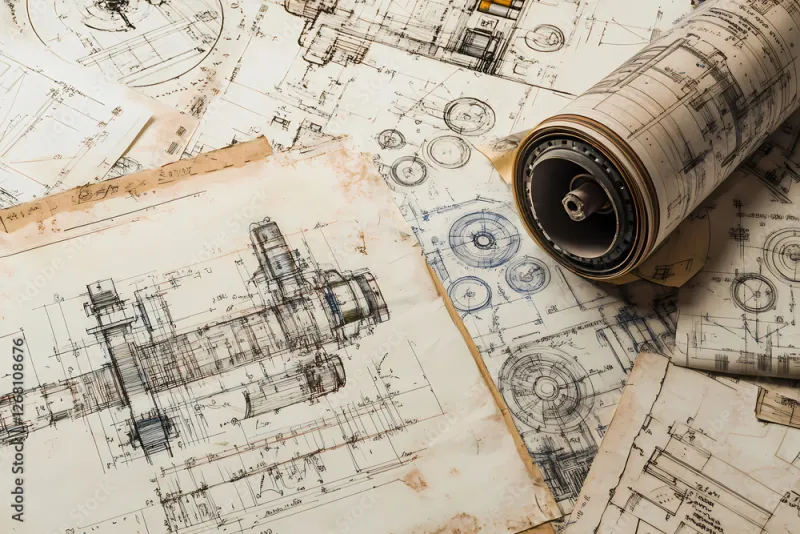
Photo: vintage Romanian engineering blueprint historical invention Eastern Europe, via as1.ftcdn.net
There's a particular kind of invisibility that comes from being geographically inconvenient. Not erased, exactly — just consistently placed at the edge of the frame, cropped out of the photo everyone shares. Romania has spent most of the last century in that cropped zone, which means a genuinely remarkable number of contributions to science, art, engineering, and culture have gone more or less unacknowledged in the countries that most directly benefited from them.
That's worth fixing. Not in a grievance-forward way — more in the way you'd want to know who actually built something you've been using your whole life without thinking about it.
The Jet Age Had a Romanian Architect
Henri Coandă is not a household name in the United States. He probably should be.
A Romanian engineer born in Bucharest in 1886, Coandă presented what he later claimed was the world's first jet-propelled aircraft at the Paris Aeronautical Salon in 1910 — decades before the jet engine became the technology that made modern commercial aviation possible. The claim has been disputed and complicated by historians over the years, as early aviation history tends to be, but what's not disputed is the Coandă Effect: a fluid dynamics phenomenon he identified and described, in which a moving fluid jet attaches to a nearby surface and follows its curvature.
That effect is now embedded in aerospace engineering, medical device design, HVAC systems, and industrial manufacturing. Every time you've been on a commercial flight — and if you're a typical American adult, that's hundreds of times — the engineering principles that keep that plane in the air have been shaped, in part, by a Romanian engineer most people have never heard of.
The Fountain Pen Problem
Petrache Poenaru isn't as technically obscure — he patented the first fountain pen in France in 1827 — but he's rarely included in the casual history of writing instruments that most people learn. The Romanian inventor, mathematician, and political reformer received French patent No. 3208 for a portable pen with a replaceable ink cartridge, solving one of the most persistent annoyances of written communication before the era of ballpoint and digital text.
He was also, notably, a major figure in the Romanian national awakening movement and helped modernize the Romanian education system. The man was not narrowly focused. But in the popular history of everyday objects, he's largely absent from the story.
Insulin's Complicated Origin Story
The Nobel Prize for insulin went to Frederick Banting and Charles Best. That's the version of history most people know, and it's not wrong — their 1921 work at the University of Toronto was decisive. But the fuller story includes Nicolae Paulescu, a Romanian physiologist who independently developed a pancreatic extract he called "pancreine" and demonstrated its blood-sugar-lowering effect in diabetic dogs — publishing his findings in a French scientific journal in 1921, months before the Toronto team's results were announced.
The Nobel Committee's decision to exclude Paulescu has been debated by medical historians for decades. His work was real, his findings were prior, and the omission has never been cleanly explained. For Romania, this is not an obscure footnote — it's a live wound in the national scientific memory. For most of the world, it simply never entered the story at all.
A Sculptor Who Changed the Language of Form
Constantin Brâncuși left Romania for Paris in 1904, walking much of the way because he couldn't afford other transport. He arrived in a city that was the center of the art world and proceeded to dismantle everything that center thought it knew about sculpture.
Brâncuși's work — the Bird in Space series, The Endless Column, The Kiss — didn't just influence modern sculpture. It essentially created the visual vocabulary that 20th-century abstract sculpture spoke in. His insistence on direct carving, on reduction to essential form, on letting material speak without ornamentation, ran directly counter to the Rodin tradition that dominated European sculpture at the time. He won.
He's celebrated in art history — the Museum of Modern Art in New York holds several of his works — but he's rarely framed as a Romanian contribution to world culture. He tends to get absorbed into "School of Paris" narratives that flatten his specific origins into a generic European modernism. The mountain he came from, the folk tradition of Romanian wood carving that clearly informed his aesthetic sensibility, gets left out of the frame.
Cinema's Debt to a Forgotten Technique
This one's less a single inventor and more a tradition. Romanian film, particularly in the 2000s and 2010s, developed a documentary-realist aesthetic — long takes, handheld cameras, non-professional actors, naturalistic dialogue — that film critics eventually labeled the "Romanian New Wave." Directors like Cristian Mungiu, Cristi Puiu, and Corneliu Porumboiu were winning at Cannes and influencing cinematography programs worldwide.
But the influence traveled quietly. American independent filmmakers who absorbed those techniques often encountered them through intermediaries — French criticism, film school syllabi, festival circuits — without the Romanian origin necessarily being foregrounded. The aesthetic spread. The attribution blurred.
Why This Keeps Happening
There's a pattern here that's worth naming directly. Romania's contributions tend to get absorbed, reframed, or credited elsewhere not because of active malice but because of structural invisibility. Countries that lack consistent soft power infrastructure — major publishing industries, dominant film industries, globally distributed news organizations — struggle to anchor their own stories in global consciousness.
The United States is exceptionally good at this kind of cultural anchoring. So is France, the UK, and Germany. Romania, positioned at the edge of Western Europe's mental map, has historically been better at producing the contributions than at ensuring they get properly labeled.
That's changing, slowly. Romanian tech companies, designers, and scientists are increasingly operating in global contexts where their origins are known and named. The Romanian New Wave gave the country a cultural calling card that stuck. Tourism — including the wave of Americans discovering Transylvania, the Carpathians, and the painted monasteries of Bucovina — is building familiarity that makes the deeper story easier to tell.
But the backlog is real. And it's larger than most people realize.
The Carpathians have been producing remarkable things for a long time. The rest of the world is just starting to look in the right direction.