The Crosses in Săpânța Talk Back—and They're Funny, Honest, and Weirdly Comforting
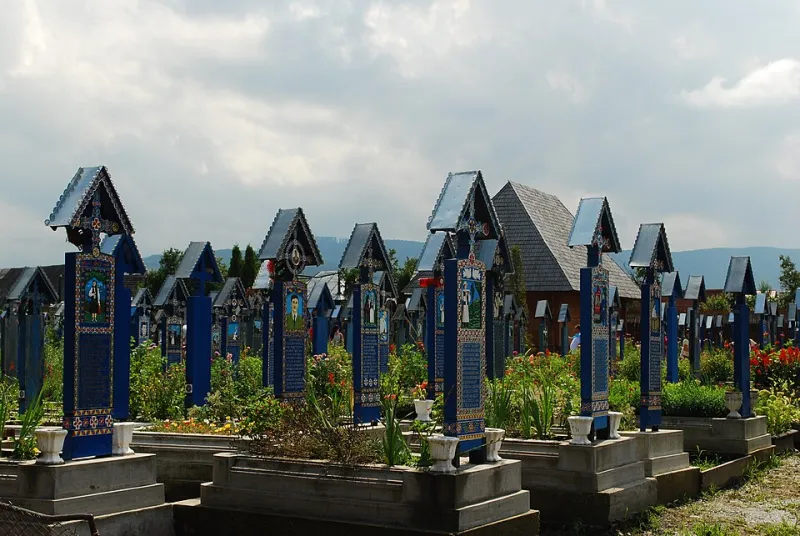
Photo: Andrei Stroe, CC BY-SA 3.0, via Wikimedia Commons
At first glance, the Merry Cemetery in Săpânța looks like a folk-art festival broke out in a graveyard. Hundreds of oak crosses crowd a hillside in Maramureș, each one painted in a deep, bright blue and carved with a scene from the life of the person underneath. A farmer drives a horse cart. A mother rocks a cradle. A man raises a glass. Then you lean closer and read the epitaph, and it says something like: this guy loved the pub more than the plow. Or: she never stopped arguing, but she also never stopped cooking. The dead are not being remembered in the polished, pasteurized language of an American funeral home. They are being introduced.
That is the first thing to understand about Săpânța. It is not a prank. It is not a dark-tourism stunt. It is a village conversation that happens to be conducted in wood.
The Woodcarver Who Started It
The tradition is usually traced to Stan Ioan Pătraș, a local woodcarver who began making these crosses in the 1930s. He kept at it for decades, training apprentices and turning a local craft into something closer to a village archive. After his death, Dumitru Pop Tincu carried the work forward. The crosses are made of oak, painted by hand, and set into the ground in rows. The blue is so associated with the place that people just call it Săpânța blue.
What Pătraș did was simple and radical at the same time. He made the grave marker a biography, not a résumé. The epitaphs are written in first person, as if the dead are speaking. They mention work, family, habits, flaws, jokes, grudges, and small victories. Some are gentle. Some are sharp. A few are basically the 1970s equivalent of a roast.
American cemeteries tend to go the other way. We like smooth granite, brief dates, and language that floats above the mess of a life. Passed away. Beloved. At rest. Even when we choose a celebration of life, we often sand the edges off the person we are celebrating. Săpânța does not sand. It paints.
Why Laughing at Death Is Not the Same as Mocking It
It would be easy to file this under dark humor and move on. But the Merry Cemetery is not really about laughing at death. It is about refusing to let death edit the story.
In villages like Săpânța, the dead were not shipped off to a discreet facility and remembered in a sanitized ceremony. They stayed part of the social fabric. People walked past the cemetery. They knew whose grandfather was a hard worker, whose aunt was a gossip, whose neighbor could drink the cellar dry. The crosses say what everyone already knew, only in paint and rhyme. That is not cruelty. It is a kind of honesty that most American families only manage after the third glass at the reception.
There is also a practical logic to it. If the dead remain characters in the village, then grief has somewhere to go besides silence. You can stand at a cross, read a joke about a man's terrible driving, and laugh. Then you can cry. The two are not enemies here.
The American Funeral Home Could Never
This is where the comparison gets uncomfortable. American funeral culture is an industry of polish. We embalm, we style, we choose the right casket lining, we write obituaries that make every person sound like a mid-level manager with a heart of gold. There is nothing wrong with dignity. But there is something missing when every life gets the same smooth finish.
Săpânța offers a different model. It says: your uncle was a difficult man who told great stories and never paid back a loan. We are going to paint him anyway. Your grandmother was fierce, funny, and exhausted. Here she is. The cross does not pretend. It remembers.
That is why the cemetery is not as dark as it sounds. It is actually one of the more life-affirming places in Europe. It treats death as a continuation of village gossip, not a sudden blackout. It lets the living keep talking to the dead, and it lets the dead keep talking back.
A Blue Cross and a Long Conversation
In 2026, Săpânța is on the tourist map. Buses come. People take photos. There is a small industry around the cemetery, and that is fine. The crosses are still being carved, still being painted, still being added. The conversation has not stopped.
What a visitor takes home is not just a souvenir photo of blue wood. It is a question. What would it look like if we remembered our dead with that kind of honesty? Not cruel. Not clinical. Just true. A little funny. A little sharp. Still in the room.
The Merry Cemetery does not ask you to laugh at death. It asks you to stop pretending that death turns everyone into a greeting card.