The New Year Romania Celebrates in January That Most Americans Have Never Heard Of
Imagine if, two weeks after December 31st, your grandparents' village still celebrated New Year's Eve. Not because they forgot, and not because they were behind on the calendar — but because they were keeping faith with a different clock entirely. A clock that measured time not by the Gregorian calendar or the Julian calendar, but by the rhythm of frozen ground thawing and seeds going back into the earth.
That's essentially what happens every January 13th in Carpathian villages across Romania. And the ritual at the center of it — called Plugușorul — is one of the most quietly remarkable surviving traditions in Eastern Europe.
Two New Years, One Country
To understand this, you need a quick detour through calendar history, which sounds dry but is actually kind of wild.
For centuries, the Orthodox Church operated on the Julian calendar, which runs thirteen days behind the Gregorian calendar that most of the world standardized on. Romania officially adopted the Gregorian calendar in 1919, but in rural communities — particularly in Moldova and parts of Transylvania — the old dates didn't disappear. They just became parallel. The official New Year happened on January 1st. The real New Year, the one tied to ancient custom and Orthodox tradition, happened on January 13th and 14th.
Locals call it Revelionul pe Stil Vechi — Old Style New Year's Eve. And while the champagne-and-fireworks version on January 1st has largely won out in Romanian cities, the Old New Year persists in villages with a tenacity that says something important about how culture actually works. It doesn't always get replaced. Sometimes it just goes underground and waits.
For American readers, the closest analogy might be something like Lunar New Year celebrations in immigrant communities — a second, layered celebration that coexists with the mainstream calendar without canceling it. Except in this case, the "immigrant community" is the original inhabitants of the land, and the tradition they're preserving is older than the country itself.
Enter the Plow
Plugușorul translates, roughly, to "the little plow," and it is exactly as charmingly agrarian as that sounds.
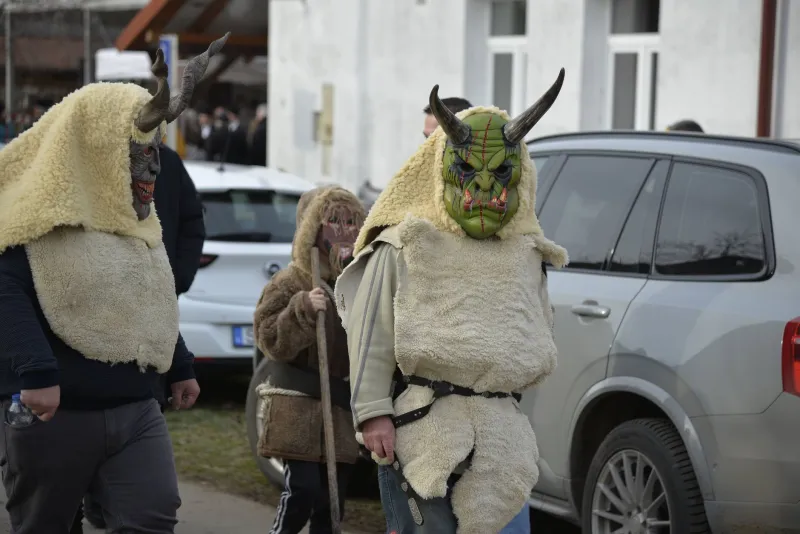
The tradition involves groups — historically young men and boys, though this varies by region — going door to door on the eve of the Old New Year, reciting long, elaborate poems or songs that describe the full cycle of agricultural labor. Plowing. Sowing. Harvesting. The poems are detailed in a way that feels almost instructional, because they once were. They were a kind of oral almanac, a ceremonial rehearsal of the year's work, performed at the threshold of a new cycle to invite abundance and good fortune into the household.
The recitation is accompanied by the sound of a buhai — a friction drum that produces a deep, resonant rumble meant to imitate the lowing of oxen. Bells are rung. Whips are cracked. The noise is deliberate; it's meant to drive out the remnants of the old year and wake up the earth for what's coming. If you've ever been to a New Orleans second line parade and felt something primal in the brass and the noise, you're in the right emotional neighborhood.
Householders who receive the plugușorul group are expected to offer food, drink, and sometimes money in return. It's a reciprocal exchange — blessings given, hospitality returned — that mirrors the logic of agricultural community life, where survival depended on mutual obligation.
Older Than the Church Will Admit
Here's where it gets historically interesting. The Catholic and Orthodox churches both incorporated this period into their liturgical calendars — January 14th is the feast of Saint Basil in the Orthodox tradition, which is why the Old New Year is sometimes called Sfântul Vasile. But the customs around Plugușorul are older than their Christian framing.
Folklorists and historians who have studied Carpathian traditions broadly agree that the ritual has pre-Christian roots, likely connected to the Roman festival of Kalends — the three-day celebration of the new year in January that the Romans observed with noise, gift-giving, and masked processions. The Roman Empire left a deeper imprint on Dacia (the ancient territory that became Romania) than many people realize. The Romanian language itself is a Romance language, a linguistic inheritance from Roman colonization. It's not a stretch to see Plugușorul as one more piece of that inheritance, reshaped by centuries of Slavic and Byzantine influence but never entirely buried.
This is a pattern that repeats throughout Carpathian folklore: Christian saints layered over pagan spirits, church feast days mapped onto agricultural turning points, new vocabularies given to very old feelings. The tradition survives not by staying pure but by staying useful.
What It Actually Sounds Like
If you've never heard a plugușorul recitation, it's worth seeking out a recording. The poems are long — sometimes genuinely epic in length — and they're performed with a rhythmic, almost hypnotic cadence. The best performers are community legends, old men who have the full text memorized and deliver it with the kind of unhurried authority that comes from knowing you're carrying something irreplaceable.
The imagery is vivid and grounded: oxen straining against cold earth, seeds falling into furrows, the slow green return of spring after a Carpathian winter that is, by any measure, serious business. There's nothing abstract or sentimental about it. This is poetry written by people who understood that a failed harvest meant hunger, and who built their rituals accordingly.
Compare that to, say, the average American New Year's countdown, which is mostly about not being alone at midnight and hoping this year is somehow better than last year. Both are responses to the same human need — to mark time, to signal hope, to gather together at a threshold. But one of them has a plow in it, and that specificity feels like it means something.
Why It Survives
Romania spent much of the twentieth century under a communist regime that was actively hostile to religious and folk practice. Plugușorul was complicated for the state — too religious for strict Marxist approval, too rural and backward-looking for a government trying to project industrial modernity. And yet it persisted, quietly, in villages and in families that kept the knowledge alive the way people keep seeds: carefully, privately, for planting later.
After 1989, there was a revival. Ethnographic festivals, village celebrations, urban Romanians reconnecting with rural roots — Plugușorul came back into public life with the energy of something that had been waiting. Today it's performed at cultural events in cities and streamed online by diaspora communities in the US, Germany, Italy, and beyond.
For Romanians living abroad, the Old New Year carries particular weight. It's a way of being connected to a place and a rhythm that distance has interrupted. The same impulse that makes a Romanian-American family in Chicago make sarmale for Christmas is the impulse that makes someone in the diaspora pull up a plugușorul video on January 13th and feel, briefly, like the distance is smaller than it is.
That's what the best traditions do. They don't just mark time. They carry people across it.