Stitched With Meaning: What American Fashion Gets Wrong About Romanian Embroidery
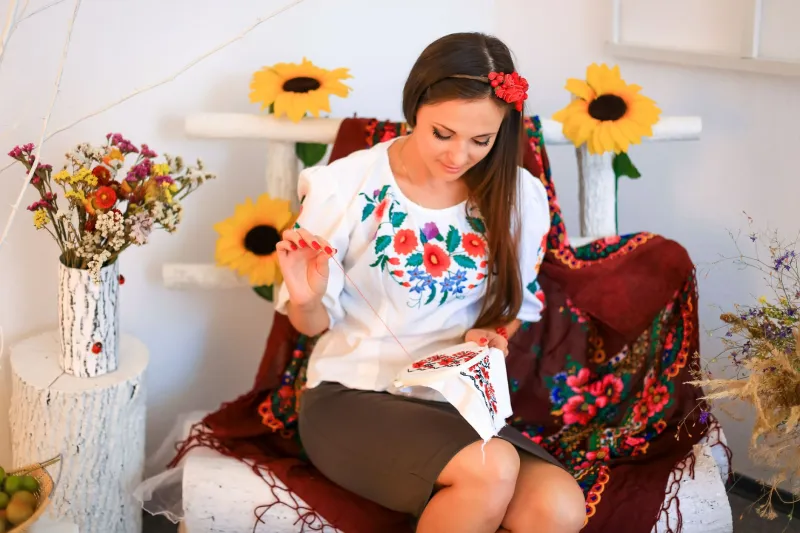
Somewhere between a Williamsburg vintage shop and a slow-fashion Instagram feed, the Romanian ie showed up. You've probably seen it without knowing what you were looking at — a white linen blouse, sleeves billowing, dense geometric embroidery crawling up the shoulders in red and black thread. It looks bohemian. It looks handmade. It looks like exactly the kind of thing that costs $180 and comes with a card explaining its "artisanal origins."
But here's the thing: that blouse might actually have artisanal origins. And that's precisely where the conversation gets complicated.
What the Ie Actually Is
The ie (pronounced roughly like "ee-yeh") is a traditional Romanian blouse worn by women across the Carpathian region for centuries. It's not a single garment with a single look — it's a living regional language written in thread. An ie from Maramureș in the north is stitched in dense black wool with angular, almost architectural motifs that reflect the harshness of mountain winters. An ie from Oltenia in the south runs warmer, with spiraling red florals that echo older Dacian solar symbols. An ie from the Transylvanian plateau might carry geometric patterns that historians link to pre-Christian fertility rites.
This isn't decorative trivia. Romanian ethnographers have spent careers cataloging these regional dialects of embroidery, because for centuries, the patterns told you who a woman was — where she came from, whether she was married, what season it was, and in some cases, what she was mourning. The ie was a visual biography worn on the body.
That context doesn't exactly fit on an Etsy listing.
How It Got Here
The ie's crossover into Western fashion isn't new, exactly — Yves Saint Laurent famously referenced Romanian folk embroidery in his 1981 collection, and the European boho wave of the 2010s pulled heavily from Eastern European textile traditions. But what's happening now in American slow-fashion circles feels different. It's quieter, more intentional, and more directly connected to actual Romanian makers.
A wave of Romanian artisan cooperatives — many based in villages in Moldova, Sibiu county, and the Apuseni mountains — have found real markets abroad through platforms like Etsy, direct Instagram sales, and partnerships with small US boutiques that specialize in ethical fashion. Women who learned embroidery from their grandmothers are now shipping hand-stitched blouses to customers in Portland and Nashville. That pipeline, when it's working honestly, is genuinely good news for rural Romanian craft communities that have watched younger generations leave for Bucharest or Western Europe.
But for every authentic cooperative, there are a dozen manufacturers in China and Turkey mass-producing "Romanian-style" embroidered blouses at a fraction of the price, with none of the cultural knowledge and none of the economic benefit flowing back to Romania.
The Knockoff Problem
This is where American consumers need to pay attention. The visual language of Romanian embroidery has been abstracted and commercialized to the point where most buyers can't tell the difference between a blouse made by a 60-year-old woman in a Maramureș village and one that rolled off a factory line in Guangzhou. Both might appear on the same search results page. Both might use the word "traditional."
The stakes aren't just aesthetic. When mass-market knockoffs flood the category, they undercut the artisans who are keeping a genuine craft tradition alive. They also strip the garment of its meaning entirely — reducing a culturally specific object to a vibe, a texture, a trend cycle.
It's a pattern (no pun intended) that Indigenous communities in the American Southwest have been fighting for decades with Navajo-inspired textiles. Romanian embroidery isn't legally protected the same way, but the ethical question is identical: who benefits when a marginalized craft tradition becomes fashionable?
What It Means to Wear Someone Else's Heritage
This is the part that tends to make people defensive, so let's be direct about it. Wearing an ie isn't inherently extractive. Romanian artisans want their work to find an audience. The craft needs buyers to survive. Cultural exchange, when it's honest and reciprocal, is genuinely valuable.
But there's a difference between buying a blouse directly from a Romanian maker who can explain what the embroidery means — and grabbing something at a festival vendor because it looks cute with your denim shorts. The first is participation. The second is consumption.
American fashion culture has a specific blind spot here. We're very good at appreciating aesthetics and very bad at asking where they come from. We've done it with Japanese indigo dyeing, with Mexican huipiles, with West African wax prints. The ie is just the latest object to pass through that particular machine.
How to Actually Engage
If you're drawn to Romanian embroidery — and honestly, it's stunning, so that's understandable — here's how to do it with some integrity:
Buy from verified Romanian sources. Look for cooperatives and individual artisans who can tell you which region their embroidery comes from and what the motifs reference. Platforms like Etsy can work, but do your homework. A real maker will almost always have a story attached.
Learn what you're wearing. Even a basic understanding of regional differences — Maramureș versus Oltenia versus Bucovina — transforms the garment from a fashion item into something with actual weight. That's a better reason to own it.
Be skeptical of suspiciously cheap "Romanian-style" anything. If it's $25 and ships from a warehouse in three days, it was not made by a woman in a Carpathian village.
Follow Romanian cultural organizations and makers online. Groups like the La Blouse Roumaine movement — which celebrates June 24th as a global day of the ie — do real work connecting international audiences with authentic tradition.
The ie has survived Ottoman occupation, communist-era cultural suppression, and the economic collapse of the 1990s. It's a remarkably durable piece of cultural heritage. The question for American audiences isn't whether to engage with it — it's whether we're willing to engage with it honestly, on terms that respect where it actually came from.