Cape, Coffin, Cliché: Hollywood's Romania Problem Isn't Going Away
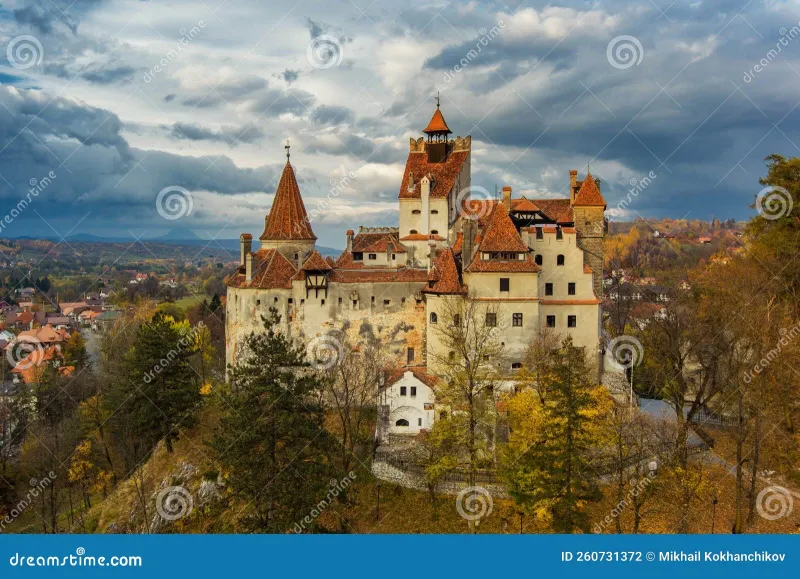
Photo: Transylvania castle landscape foggy cinematic Romania, via thumbs.dreamstime.com
Let's play a quick game. Close your eyes and think of Romania as American pop culture has taught you to picture it. What do you see?
Fog. Cobblestones. A castle on a hill. Maybe a guy in a cape. Possibly a wolf somewhere in the background. A villager crossing themselves. Lots of candles.
Now open your eyes, because none of that is Romania. Or rather — almost none of it. Transylvania is real. The castles are real. But the story that's been draped over all of it is almost entirely an Anglo-American invention, laundered through Bram Stoker and a hundred years of Hollywood horror, until the projection became more familiar than the place itself.
This is a problem. And it's worth talking about why.
What Gets Left Out When You Only Make Room for Dracula
Romanian folklore is genuinely extraordinary. Not in a needs-Hollywood-approval way — in a this-stands-on-its-own-completely way. The haiducii tradition alone is enough to sustain a dozen prestige dramas: outlaw bands operating democratic mountain societies, stealing from corrupt nobles, sheltered by peasant communities who saw them as folk heroes. Think Robin Hood meets The Revenant meets a Balkan Succession, with better ethics and worse weather.
Then there's the doina — a musical form of longing so specific and so deep that UNESCO recognized it as an intangible cultural heritage. There are the iele, fairy-like spirits who can grant gifts or drive you to madness depending on how you encounter them. There are the traditions around Mărțișor, around the Sânziene, around the moroi and the strigoi — which are related to but meaningfully different from the vampire mythology the West collapsed them into.
None of this is obscure. It's just not convenient for a particular kind of story.
The Comfortable Narrative of Eastern European Darkness
Here's the uncomfortable part: Hollywood's Romania isn't really about Romania. It's about what Western audiences need Eastern Europe to be.
Gothic Eastern Europe serves a specific function in American pop culture. It's the place where the uncanny lives. Where the past hasn't died yet. Where superstition and shadow persist because the people there are behind — developmentally, culturally, civilizationally. It's the dark backdrop against which Western rationalism gets to look heroic.
This is a colonial storytelling habit, and it runs deep. Romania gets cast as atmosphere rather than subject. Its culture becomes set dressing. Its people show up as either menacing or pitiable, rarely as the protagonists of their own complex history.
When a Romanian character appears in an American production, ask yourself: do they have interiority? Do they have a history that exists outside their relationship to the Western protagonist? Do they have humor, ambition, grief, irony? Or are they a function of the plot — the mysterious local, the fearful villager, the exotic love interest?
The answer is almost always the latter.
The Storytelling That's Actually There
What makes this frustrating is that Romanian narrative tradition is rich with exactly the kinds of stories that American audiences are currently hungry for.
The haiducii stories are morally complex in ways that modern audiences claim to want. The heroes aren't clean. They operate outside the law because the law is corrupt. They build alternative systems of justice because the official ones have failed. They're beloved and feared simultaneously, celebrated in song and demonized by the powerful. That's not a simple story. That's a great story.
Romanian fairy tales — the basme — operate on a completely different logic than their Western European counterparts. The hero's journey looks different. The magic follows different rules. The moral universe is less binary. There's room for ambiguity, for trickery, for outcomes that don't resolve cleanly. That's not a flaw. That's sophistication.
And the oral tradition — the way these stories were carried, modified, argued over, and passed down through generations of communities who had very good reasons to encode their history in narrative — is a masterclass in what storytelling actually does when it has to do real work.
Why Authentic Stories Threaten the Comfortable Version
Here's the thing about replacing cliché with reality: it requires the audience to do something harder than consume. It requires them to encounter people and places on their own terms rather than through a familiar filter.
Gothic Romania is easy. You already know how to watch it. You know the beats, the sounds, the lighting. You know what to feel and when.
Actual Romanian folklore — the haiducii, the doina, the layered mythology of the Carpathians — asks you to slow down and learn something. It asks you to hold complexity. It doesn't come pre-translated into a genre you already own.
That's harder to sell. But it's not impossible. The global appetite for non-English storytelling has never been higher. Romanian filmmakers — and there are brilliant ones — are already doing this work. The question is whether American distributors, streamers, and studios will eventually catch up, or keep reaching for the cape.
The Cost of Getting It Wrong
This isn't just a cultural complaint. Misrepresentation has real downstream effects. It shapes how Americans think about Eastern European immigration and Eastern European policy. It shapes what gets funded, what gets greenlit, what gets translated. It shapes whether a Romanian American kid grows up seeing their heritage as something rich and worth knowing, or as a joke the rest of the world is in on.
Romania has a story worth telling. Many of them, actually. They've been told, in Romanian, for centuries. The question is whether anyone outside the Carpathians is finally ready to listen.