Romania's Most Haunted Forest Has Nothing to Do with Dracula — And That's What Makes It Terrifying
Romania's Most Haunted Forest Has Nothing to Do with Dracula — And That's What Makes It Terrifying
There's a forest just outside Cluj-Napoca, tucked against the western edge of Transylvania, that has been quietly terrifying people for centuries. Not in the theatrical, fog-machine-and-plastic-coffin kind of way. In the slow, wrong-feeling, why-does-my-compass-not-work kind of way. It's called Hoia-Baciu, and if you've heard of it at all, you probably heard it described as "the world's most haunted forest" in some listicle that also mentioned Area 51 and the Bermuda Triangle.
But here's what those articles almost never tell you: Romanians were scared of this place long before any foreign journalist showed up with a camera crew.
The Forest Before the Hype
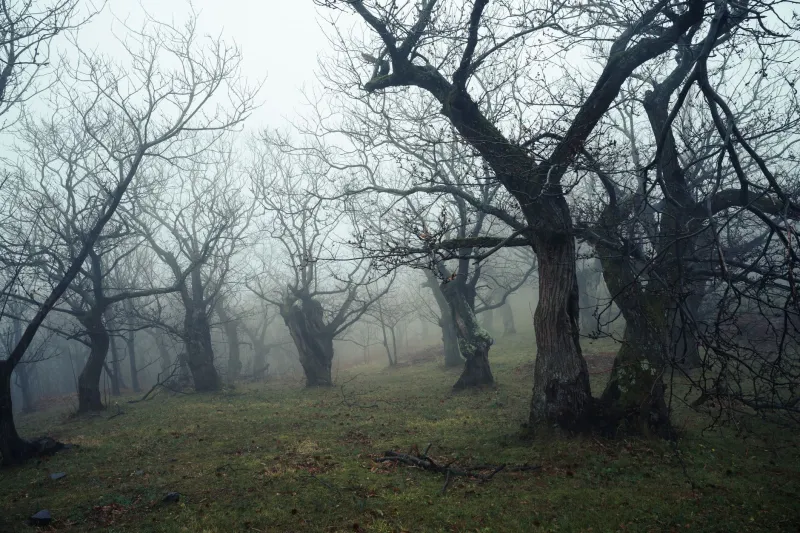
Hoia-Baciu sits on roughly 750 acres of dense woodland, and it has a look about it that's hard to shake. The trees grow in strange, spiraling patterns — trunks bent and twisted in directions that don't follow any obvious logic of wind or soil. The canopy closes in unevenly, leaving random clearings that feel less like natural gaps and more like something made a decision to stop growing there.
Local lore has circled this forest for generations. Shepherds in the area passed down stories about livestock that wandered in and never came back. Villagers spoke of a persistent unease — headaches that hit you crossing the tree line, rashes that appeared without explanation, a sense of being watched that didn't go away when you turned around. These weren't stories invented for tourists. They were cautionary folklore, the kind of thing grandmothers told grandchildren with the same practical urgency as "don't swim after eating."
The name itself carries weight. "Hoia" is believed by some researchers to reference a shepherd — a man named Horea, by some accounts — who disappeared in the forest along with his flock of two hundred sheep. No remains. No explanation. Just gone. That story predates any modern paranormal investigation by a wide margin, and it's the kind of foundational mystery that tends to accrete legend the way old wood collects moss.
When the Scientists Showed Up
The forest got its first brush with outside attention in 1968, when a military technician named Emil Barnea photographed what he claimed was a disc-shaped object hovering over the trees. The image circulated. Researchers came. And Hoia-Baciu's reputation shifted from local ghost story to international anomaly.
Biologist Alexandru Sift had already been documenting strange vegetation patterns in the forest for years before Barnea's photograph. He catalogued the unusual tree growth, photographed unidentified aerial objects himself, and reported experiences — dizziness, anxiety, a feeling of time slipping — that he couldn't attribute to anything in his scientific toolkit. These weren't fringe figures. They were credentialed people writing up observations they couldn't explain, which is somehow more unsettling than a ghost story told around a fire.
What followed was decades of investigation by Romanian parapsychologists, folklorists, and eventually a wave of international paranormal enthusiasts who arrived in the 1990s and 2000s armed with EVP recorders and expectations shaped by American reality television.
What Locals Actually Think
Here's where it gets interesting, and where the gap between local experience and exported narrative becomes most visible.
For many Cluj-Napoca residents, Hoia-Baciu isn't a destination — it's a boundary. You don't go in there at night. Not because you believe in ghosts, necessarily, but because the forest has a reputation that's been earned over enough generations that dismissing it entirely feels foolish. It's the same instinct that keeps sensible people from swimming in an unfamiliar lake after dark. You don't have to believe in sea monsters to respect deep water.
The tourists who arrive expecting a theme park experience sometimes leave confused. The forest doesn't perform. There are no jump scares, no designated haunted spots marked with signs. What there is, consistently reported across decades and across cultures, is an ambient wrongness — a sensory experience that resists easy categorization. Some visitors feel nothing. Others come out with anxiety they can't explain, or photographs with light anomalies, or a vague conviction that they left something behind in there.
Romanian anthropologists have pointed out that Hoia-Baciu sits in a region with a long history of liminal spaces in local cosmology. In Carpathian folk belief, forests have always occupied a threshold position — they are where the rules of the village stop applying, where spirits move more freely, where the boundary between the living world and whatever comes next grows thin. The forest wasn't considered evil, exactly. It was considered other. That distinction matters.
The Dracula Problem
Western media has an almost compulsive need to route everything Romanian and spooky through Bram Stoker. Hoia-Baciu gets this treatment constantly, despite the fact that Stoker never set foot in Romania, based his Transylvania largely on secondhand accounts and his own imagination, and almost certainly never heard of a forest outside Cluj.
The Dracula connection is a marketing convenience, not a cultural truth. And leaning on it actually flattens something more interesting: Romania has a rich, layered tradition of supernatural folklore that has nothing to do with Victorian Gothic fiction. The strigoi, the moroi, the iele — these are creatures and forces with specific rules, specific histories, specific relationships to the land and the people who worked it. They don't need Dracula to be compelling. They were compelling for centuries before Stoker was born.
Hoia-Baciu fits into that older, stranger tradition. It's not a haunted house. It's a place where the pre-Christian understanding of the natural world — that forests are alive, that land holds memory, that some places accumulate energy the way old buildings accumulate stories — has stubbornly refused to be modernized away.
Why It Still Matters
There's a version of Hoia-Baciu that gets packaged and sold as a quirky bucket-list stop, something to screenshot for the algorithm between visits to Bran Castle and a papanași restaurant. And there's the version that has existed in Carpathian consciousness for centuries — a place that commands a specific kind of respect, not because of what it might do to you, but because of what it represents.
The forest is a reminder that some landscapes carry the weight of everything that happened in them. And in a region that has seen the full sweep of human history — empires, wars, displacement, survival — that weight is considerable.
You don't have to believe in UFOs or ghosts to find that meaningful. You just have to be willing to stand at the tree line and feel something you can't immediately explain.
Most people, it turns out, are.